Trust as a Competitive Advantage
Trust is often treated as a soft issue in AI. It is not. In practice, trust affects adoption, customer retention, partner confidence, regulator tolerance, internal uptake, and long-term brand strength. That means responsible AI practice can create strategic advantage, not only defensive protection.[2], [12], [21], [34], [63], [91], [94], [95]
The organisations that sustain AI advantage are unlikely to be those that move fastest without control. They are more likely to be the ones that combine speed with credibility, clarity, and dependable governance. The strategic question is not only whether a system works. It is whether people are willing to rely on it, defend it, buy from it, or keep using it over time.
The most useful way to read this chapter is through six questions:
- Why is trust a strategic asset, not only an ethics concern?
- What actually creates trust in AI use?
- Why is explainability useful but not sufficient?
- Which stakeholders need different forms of trust evidence?
- How does trust become market advantage rather than compliance cost?
- What should leaders measure if they want trust to compound?
1. Why Is Trust A Strategic Asset, Not Only An Ethics Concern?
The leadership mistake is to treat trust as reputation management that matters only after controversy. In reality, trust shapes whether AI use scales at all:
- staff adopt or resist it
- customers stay or leave
- partners deepen or narrow the relationship
- regulators tolerate experimentation or intensify scrutiny
- leadership can move faster or becomes trapped in defensiveness
That is why trust belongs in strategy. It influences not just legitimacy, but also adoption friction, oversight cost, and the organisation’s room to maneuver under uncertainty.[12], [21], [34], [91], [94], [95]
The first trust screen is easiest to read through four lenses:
| Lens | What To Ask | Why It Matters |
|---|---|---|
| Reliability | Do people believe the system is dependable enough for this context? | Weak reliability undermines use before scale arrives |
| Legibility | Can people understand what the system does, where it is used, and what its limits are? | Invisible systems are harder to trust and harder to defend |
| Accountability | Is it clear who remains responsible when something goes wrong? | Trust weakens quickly when responsibility is vague |
| Fairness and challenge | Can affected people question, contest, or escalate outcomes? | Contestability is central to durable legitimacy |
2. What Actually Creates Trust In AI Use?
Trust is rarely produced by one thing. It usually emerges from a combination of signals:
- the system is reliable enough in the real workflow
- humans remain visibly accountable
- the use case is understandable and justified
- safeguards and escalation paths are usable
- communication is honest about capability and limitation
This is why trust is not the same as high model performance. A technically strong system can still be distrusted if it is opaque, overclaimed, badly introduced, or impossible to challenge. Conversely, a narrower system with modest capability can earn stronger trust if its use is clear, bounded, and governable.[2], [12], [21], [63], [91], [94], [95]
3. Why Is Explainability Useful But Not Sufficient?
Explainability belongs here because trust is not created by accuracy claims alone. Stakeholders are more likely to trust AI when they can understand what the system is for, what its limits are, when humans remain accountable, and how important outputs can be interpreted or challenged.[52], [60], [63]
But explainability is only one trust mechanism. It does not guarantee correctness, fairness, or legitimacy on its own.
For leadership teams, explainability helps in four specific ways:
- it makes high-impact outputs easier to review and justify
- it improves user confidence when explanations are relevant and usable
- it strengthens communication with customers, auditors, and regulators
- it supports governance, debugging, and challenge when outcomes are disputed
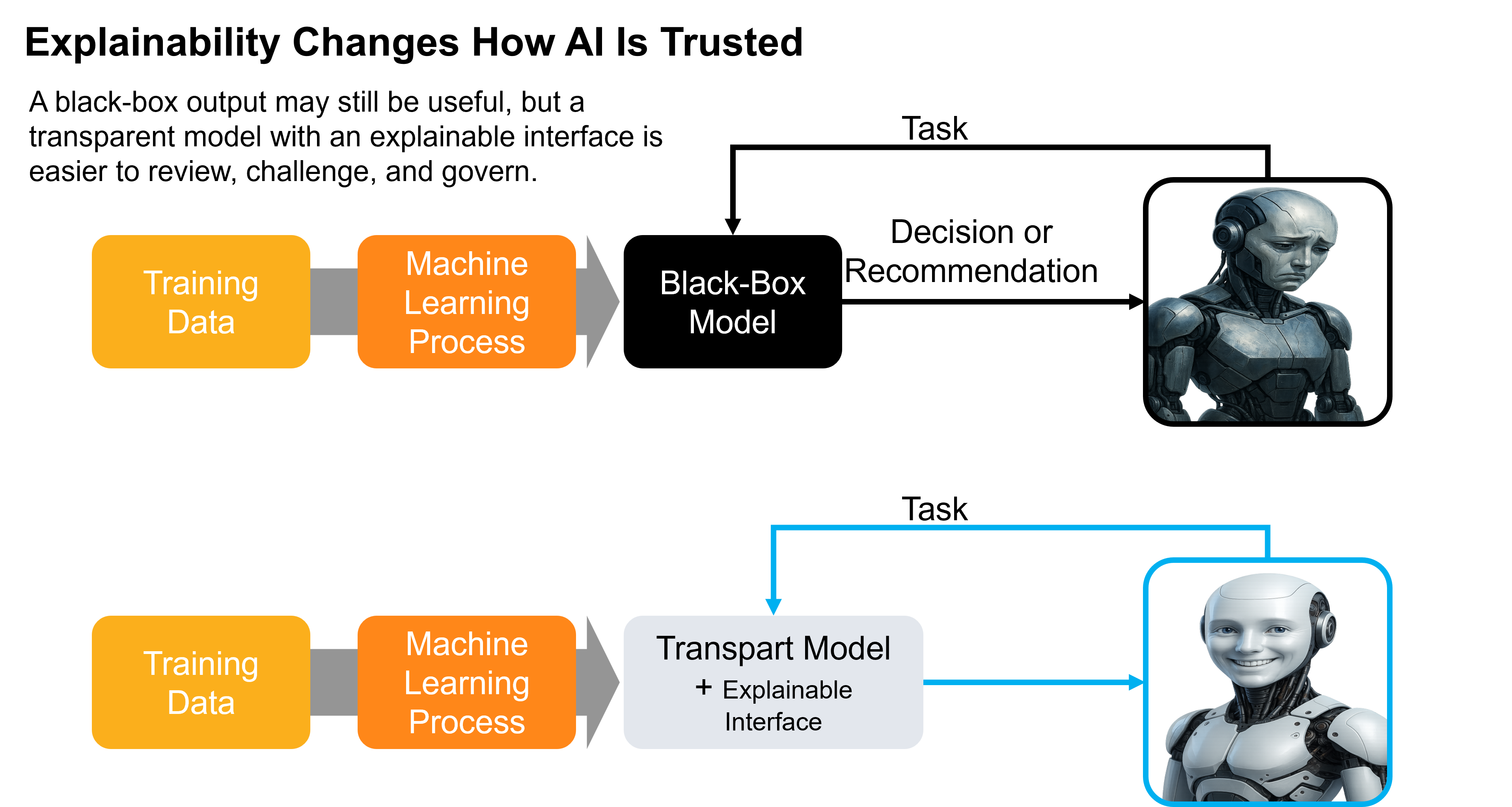
Figure: explainability does not guarantee correctness, but it improves the ability of users, managers, auditors, and regulators to understand, challenge, and govern important outputs.
The practical warning is important: leaders should not confuse some explanation with earned trust. Trust still depends on whether the explanation is meaningful for the audience, whether the system behaves dependably, and whether the surrounding governance is credible.
Trust View
| Trust Driver | Leadership Question | What Good Looks Like |
|---|---|---|
| Reliability | Does the system perform consistently enough in context? | Users can see that it works under real conditions |
| Explainability | Can important outputs be understood and challenged? | Explanations support review, not just marketing claims |
| Accountability | Is responsibility visible after deployment? | Owners, reviewers, and escalation rights are clear |
| Institutional behavior | Does the organisation communicate and respond credibly when problems arise? | Trust survives failure because response is disciplined |
4. Which Stakeholders Need Different Forms Of Trust Evidence?
Explainability and trust are not single-audience requirements. Different stakeholders need different forms of evidence.
- Users and staff need enough clarity to know when to rely on the system and when to challenge it.
- Customers and affected individuals need understandable reasons, fair treatment, and a path to contest outcomes.
- Regulators and auditors need evidence that decisions can be reviewed, justified, and governed.
- Builders and operators need explanations that help them improve the system and detect weak behavior.
- Executives and boards need signals that support governance, accountability, and strategic judgment.
That is why generic transparency language is often weak. Trust grows faster when explanation, evidence, and communication are matched to the people who actually need to rely on them.[52], [60], [63], [91], [95]
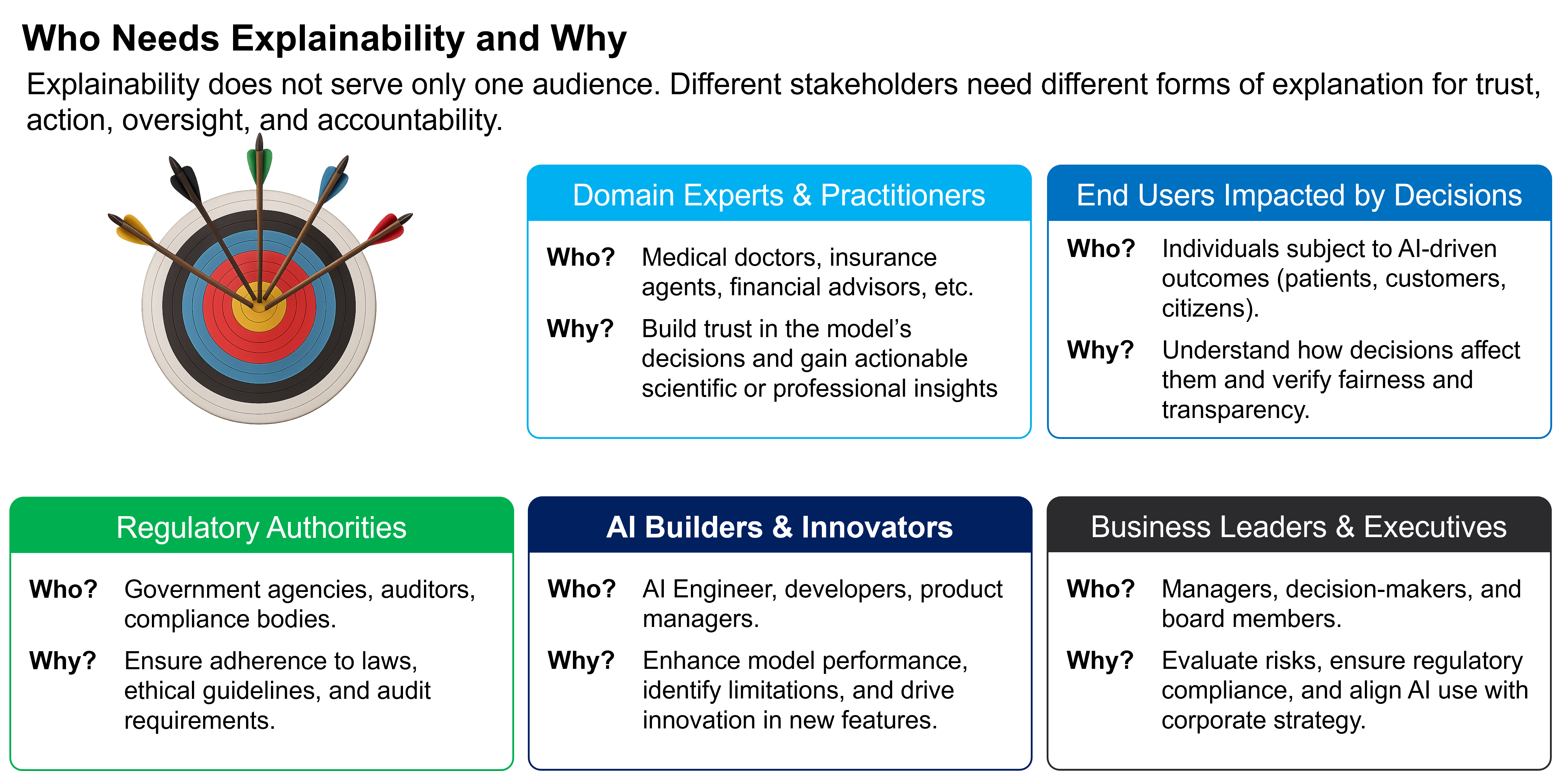
Figure: explainability serves different purposes for different stakeholders, from operational trust and debugging to regulatory review and executive oversight.
5. How Does Trust Become Market Advantage Rather Than Compliance Cost?
Trust becomes strategic when it changes the economics of adoption.
It can:
- lower resistance to deployment
- shorten the path from pilot to sustained use
- improve customer and partner willingness to engage
- reduce the cost of repeated reassurance, escalation, and remediation
- make the organisation more resilient when competitors trigger controversy or scrutiny
This is where trust becomes more than messaging. It changes how much friction the organisation faces when it introduces new AI capabilities. In some sectors, that friction difference can be a meaningful competitive edge.[21], [34], [63], [94], [95]
6. What Should Leaders Measure If They Want Trust To Compound?
If leaders want trust to compound, they should measure more than model accuracy and usage growth.
Useful signals often include:
- user willingness to rely on the system in the intended context
- override, complaint, and contestation patterns
- whether explanations are understood and used in practice
- customer or partner confidence in the organisation’s AI posture
- time lost to clarification, remediation, or escalation
- whether trust improves after incidents are handled, not only before they occur
These measures are imperfect, but they are closer to the real strategic question: is the organisation becoming easier or harder to trust as AI use deepens?
Leadership Context
- B2B firms should treat trust as part of sales confidence, procurement success, and partner assurance.
- Consumer-facing organisations should expect trust to affect retention, complaint pressure, and brand resilience directly.
- Public institutions should treat trust as part of legitimacy and service acceptance, not only public relations.[21], [23]
- Highly regulated sectors should use trust evidence to support market access and supervisory confidence, not just to survive audit.[63]
Final Perspective
Trust is not a slogan that sits beside AI strategy. It is one of the things that determines whether AI strategy holds up under real use.
After reading this chapter, a leadership team should be more disciplined in four ways:
- treat trust as a driver of adoption, legitimacy, and strategic room to maneuver
- use explainability as one trust mechanism, not the whole trust model
- match trust evidence to the stakeholder who actually has to rely on it
- measure whether trust is compounding or being spent down as AI use expands
The practical change is to stop asking only can this system perform? and start asking will the people around it keep trusting us if we scale it?
Key Questions for Leaders
- What does trust mean in our sector and stakeholder context?
- Which transparency and accountability practices create real confidence rather than generic messaging?
- Where is trust reducing friction, and where is mistrust slowing adoption?
- How can responsible AI become part of our market position rather than only a control response?