AI Law, Regulation, and Financial Exposure
AI regulation is no longer something leaders can treat as distant. New AI rules are already taking effect in major jurisdictions, while existing privacy and consumer-protection laws are being used against AI-enabled practices today. That makes AI compliance part of current operations, not a topic to watch from the sidelines.[4], [5], [6], [64]
Leaders do not need to master every legal article. They do need to understand where exposure sits: what systems are in scope, which roles carry responsibility, what evidence regulators may expect, and how fines, injunctions, contract disputes, or public scrutiny could affect the organisation.
The most useful way to read this chapter is through six questions:
- Why is AI law already a current operating issue?
- Which legal frameworks matter most first?
- Why does exposure often start before a new AI law applies?
- Why does third-party AI not transfer responsibility?
- When does explainability become a legal and regulatory issue?
- What does financial exposure really include?
1. Why Is AI Law Already A Current Operating Issue?
The core leadership mistake here is to assume that legal risk begins only when a new AI-specific law arrives. In practice, exposure usually begins earlier:
- when an AI system touches personal data
- when it affects rights, access, pricing, eligibility, or safety
- when a vendor tool is deployed without enough internal oversight
- when the organisation cannot explain, document, or justify how the system is being used
The practical consequence is that AI law is not just about upcoming regulation. It is also about how long-standing legal duties are now being enforced against newer systems and workflows.[6], [7], [64]
For executives, the legal landscape is easiest to read through four lenses:
| Lens | What Creates Exposure | Why It Matters |
|---|---|---|
| AI-specific rules | Risk-based obligations and prohibited uses | Some deployments carry explicit governance duties |
| Existing data law | Personal-data processing and automated decisions | Exposure often starts before any AI-specific review |
| Sector rules | Finance, healthcare, employment, procurement, safety | Domain regulation can bite even without omnibus AI law |
| Enforcement and claims | Consumer protection, contracts, audits, complaints, litigation | Financial exposure is broader than formal fines |
For management teams, the mistake is waiting for one clear regulatory event. By the time that event is obvious, exposure may already have built up through privacy, sector, procurement, or consumer-protection routes.[6], [34], [64]
2. Which Legal Frameworks Matter Most First?
EU AI Act
The EU AI Act is the first comprehensive cross-sector AI law now in force at regional scale.[4], [5] Its reach is not limited to EU-headquartered companies: it can apply where AI systems are placed on the EU market or used in ways that affect people in the EU.[4], [5]
The Act categorises AI systems by risk level:
| Risk Level | Examples | Requirements |
|---|---|---|
| Unacceptable risk | Social scoring, certain manipulative uses, several prohibited biometric practices | Prohibited |
| High risk | Hiring tools, credit scoring, certain education, critical infrastructure, medical and law-enforcement uses | Risk management, documentation, data governance, human oversight, logging |
| Limited / transparency risk | Chatbots, deepfakes, some AI-generated public-facing content | Disclosure and transparency obligations |
| Minimal risk | Spam filters, AI in video games | No specific requirements |
Interactive Figure
EU AI Act: risk tier, obligations, and timing
Select a risk tier to see what the Act does to that category. The main point is that the law is not one flat rulebook: different uses trigger very different obligations.
Some AI uses are prohibited outright
The AI Act bans certain uses because the risk is considered incompatible with EU law and values rather than something to be managed through controls alone.
Social scoring, certain manipulative uses, and several prohibited biometric practices.
The right response is not stronger documentation. It is to avoid the prohibited practice.
Clear screening of use cases before deployment and a process to escalate anything that may fall into a banned category.
Are we trying to govern something that the Act treats as impermissible in the first place?
Act entered into force
Prohibited practices and AI literacy duties apply
Governance and GPAI model obligations apply
Most of the Act becomes fully applicable
Longer timetable for some regulated high-risk products
Key idea: the AI Act is a tiered regime. The harder the potential impact, the stronger the obligations, evidence, and governance burden.
The timetable is phased, and the dates matter. The AI Act entered into force on August 1, 2024. Prohibited practices and AI literacy obligations started to apply on February 2, 2025. Governance rules and obligations for general-purpose AI models became applicable on August 2, 2025. The Act becomes fully applicable on August 2, 2026, with some high-risk systems embedded in regulated products following a longer timetable to August 2, 2027.[4], [5], [42]
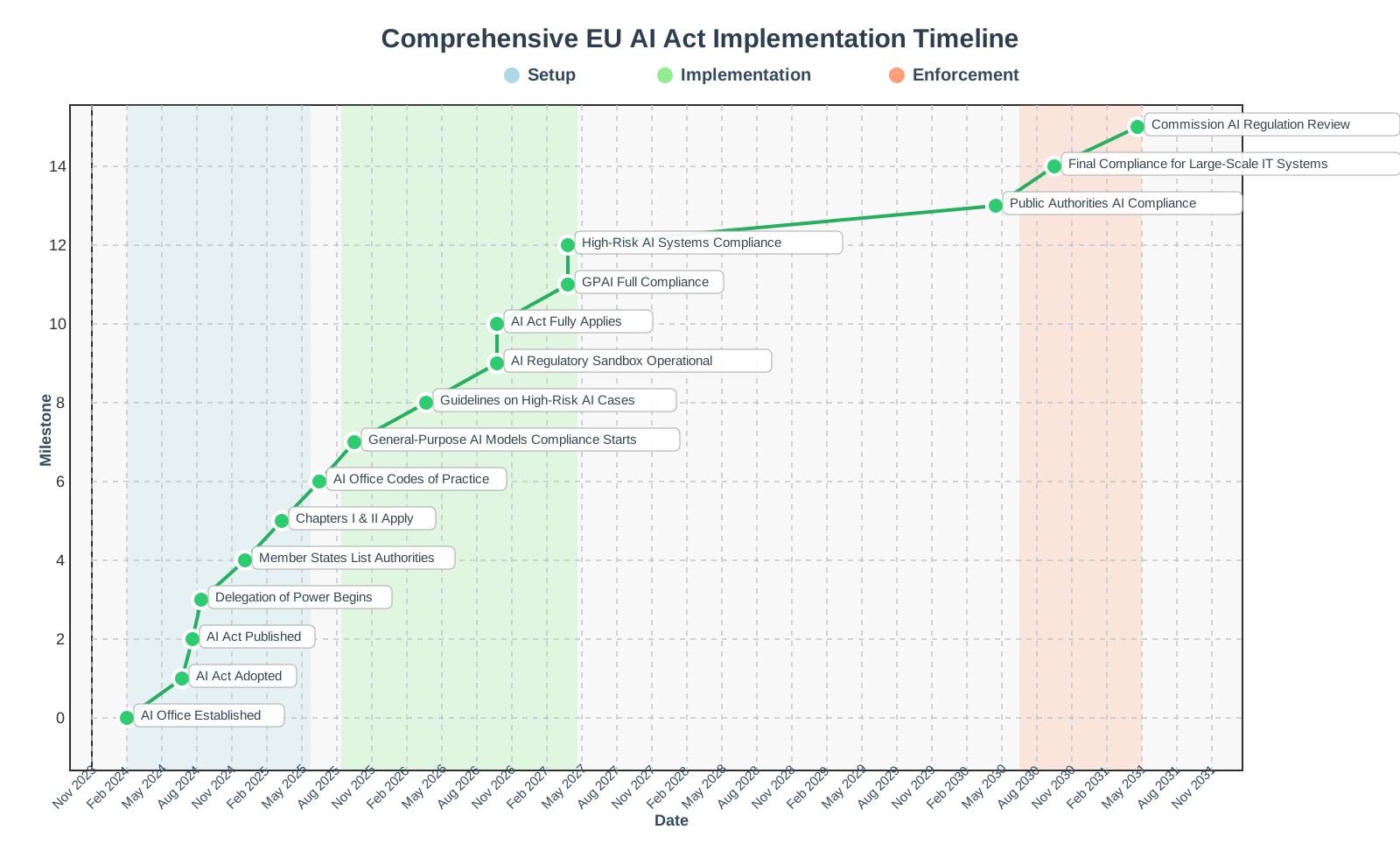
Figure: a plotted timeline of major EU AI Act milestones, showing how obligations and reviews are phased over several years rather than arriving all at once.
The practical point for leaders is simple: waiting for “full implementation” is not a compliance strategy.
Penalties: For the most serious violations, the AI Act provides for fines that can reach €35 million or 7% of worldwide annual turnover, depending on the category of breach.[4], [5]
When Does CE Marking Matter?
Not every AI use creates a CE-marking question. An internal drafting tool, decision-support workflow, or employee copilot may create governance, privacy, and documentation obligations without becoming a CE-marked product issue. CE marking is the symbol used in the European Union to show that a covered product declares conformity with the relevant EU product rules before it is placed on the market. CE marking enters the picture when AI is part of that product compliance pathway: for example when the AI system is itself regulated as a product, is a safety component of a product, or sits inside a product category governed by Union harmonisation legislation.[5], [42], [101]
That distinction matters because the management model changes. Once AI enters a product-facing conformity path, the organisation may need technical documentation, a formal conformity assessment route, an EU declaration of conformity, post-market obligations, and in some cases third-party assessment by a notified body before the product can be placed on the market.[5], [42], [101]
The practical leadership mistake is to treat all AI as if it raised only policy and workflow questions. Some uses do that. Others create market-access and product-compliance questions as well.
How The AI Act Connects To The Wider EU Digital And Product Rule Stack
Leaders should not read the AI Act as if it were the only relevant European rulebook. In practice, AI often sits inside a wider stack of obligations:
- GDPR still governs personal-data processing, data-subject rights, and automated decision issues.[6], [7]
- The AI Act adds AI-specific duties around prohibited uses, risk classification, documentation, governance, human oversight, and general-purpose AI.[4], [5]
- The Cyber Resilience Act matters for products with digital elements and introduces cybersecurity-by-design, vulnerability handling, and CE-marking implications for covered products.[101]
- The Data Act matters when value, switching, and access rights depend on data generated by connected products or industrial equipment.[102]
- Sector product and safety rules still matter in health, machinery, finance, critical infrastructure, procurement, and employment.[4], [5], [42]
This is why the leadership question is larger than are we compliant with the AI Act? The better question is which legal pathway does this use create: governed workflow, regulated product, connected product, or high-impact decision system?
The regulatory picture is also still moving. The European Commission’s AI Act FAQ notes that on November 19, 2025 the Commission proposed, as part of the Digital Omnibus package, adjustments to the timing of some high-risk obligations.[42] That does not eliminate the need for preparation. It means leaders should watch current implementation guidance rather than freeze their strategy around one assumed timetable.
Strategy, Product Compliance, And Governance: What Changes When
| Situation | Main Leadership Question | Primary Regulatory Lens | What Changes In Practice |
|---|---|---|---|
| Internal AI use in ordinary workflows | Are we governing use, data, and accountability well enough? | Governance, GDPR, sector rules | Focus on approval, data handling, documentation, monitoring, and workforce guidance |
| AI in higher-impact decisions | Can we defend the decision path, oversight, and evidence? | AI Act, GDPR, sector rules | Stronger classification, review, documentation, challenge, and explainability needs |
| AI embedded in regulated or CE-marked products | Does this create a product conformity and market-access pathway? | AI Act plus product legislation and, where relevant, CE marking and notified bodies | Technical documentation, conformity assessment, declaration of conformity, product assurance, post-market duties |
| AI in connected products or software | Are cyber and data obligations changing the business case? | AI Act, Cyber Resilience Act, Data Act | Security-by-design, vulnerability handling, data access and switching implications, broader product evidence |
| GPAI reliance through vendors | Are we dependent on providers whose obligations and evidence standards are changing? | AI Act rules for general-purpose AI (GPAI) models, Code of Practice, contract and vendor governance | Stronger vendor diligence, transparency review, copyright and safety questions, supplier evidence expectations |
GDPR and AI
Many AI systems process personal data and are therefore subject to GDPR. Key implications include:[6], [7]
- Solely automated decisions that produce legal or similarly significant effects raise Article 22 issues and require careful safeguards
- Data minimisation, purpose limitation, and lawful-basis requirements constrain how training and inference data can be collected and reused
- Access, deletion, objection, and other data-subject rights can complicate AI lifecycle management, especially where personal data is embedded in workflows or vendor systems
Legal scholarship and regulatory guidance make a narrower but more useful point: there is not a simple standalone “right to explanation” covering every automated decision, yet accountability duties around automated decision-making still create real operational expectations.[60], [63]
Penalties: Up to €20 million or 4% of global annual turnover.[6]
Sector-Specific Regulation
Many industries face additional AI-specific requirements:
- Financial services: Model risk management, explainability requirements
- Healthcare: Medical device regulation for diagnostic AI
- Employment: Anti-discrimination law applied to AI hiring tools
In the United States and other jurisdictions, sector regulators may act even without a single omnibus AI law. Consumer protection, anti-discrimination, product liability, procurement, and professional duty rules can still create meaningful enforcement risk.[64]
Comparative Jurisdictional Direction
Leaders operating across multiple markets should expect regulatory divergence. The EU approach is more codified and risk-classification-driven. The United States remains more fragmented and executive- and enforcement-led across agencies and sectors, with the White House’s America’s AI Action Plan, released on July 23, 2025, framing federal priorities around innovation, infrastructure, and international diplomacy and security.[41] Other jurisdictions, including China and several regional regulators, are developing their own governance models with different expectations around transparency, security, data use, and platform control.
For multinational organisations, the practical burden is rarely a single rulebook. It is the need to align products, controls, documentation, and vendor management across different legal environments.
3. Why Does Exposure Often Start Before A New AI Law Applies?
For most leadership teams, exposure begins in five places:
- Use-case choice: a low-stakes drafting assistant and a hiring-screening system do not create the same legal burden.
- Data handling: personal data, sensitive data, and cross-border data movement can trigger obligations before any model issue is even examined.
- Vendor dependency: using a third-party tool does not transfer accountability for harmful deployment, poor oversight, or weak internal controls.
- Documentation gaps: if the organisation cannot show what was assessed, approved, monitored, and escalated, it becomes harder to defend the system.
- Public-facing use: customer interaction, employee impact, or high-visibility use raises the chance of complaints, scrutiny, and reputational escalation.
Interactive Figure
Where legal exposure usually starts
Select an exposure point to see what creates risk, what leadership teams often miss, and what to check before the system spreads further.
Legal burden changes sharply when AI affects consequential decisions rather than low-stakes drafting or support work.
Hiring, pricing, access, eligibility, safety, and rights-affecting decisions create much higher legal sensitivity.
Teams often treat all AI use as one category and miss how quickly obligations change when the workflow becomes consequential.
Ask which rights, decisions, or business outcomes the system can influence and whether that use has been formally approved.
Separate low-stakes assistance from high-impact decision support before governance, procurement, and review all blur together.
Key idea: legal exposure usually starts in the workflow, data, and governance choices around the system before it appears as a formal compliance event.
Rights, pricing, eligibility, and safety create a different legal burden from low-stakes drafting support.
Personal data, sensitive data, and cross-border movement can create exposure before model quality is even debated.
Model providers can reduce build effort without absorbing deployment, oversight, or customer-facing risk.
If approvals, limits, and monitoring are not visible, the organisation will struggle to defend how the system was used.
Customer-facing and employee-facing systems can turn local failures into broader reputational and regulatory problems.
Figure: legal exposure often begins before formal enforcement, in the design, data, vendor, documentation, and public-impact choices around the system.
This is why legal exposure often shows up first as an operating failure rather than as a formal legal label. The tool is already live, the documentation is thin, the vendor terms are imprecise, and the organisation cannot clearly show who approved the deployment or under what conditions.[32], [34], [61], [62]
4. Why Does Third-Party AI Not Transfer Responsibility?
One persistent executive mistake is to assume that buying AI from a vendor shifts the legal burden to the supplier. It does not.
In practice, third-party AI can reduce development burden while leaving the deployer exposed on:
- procurement choices
- lawful basis and data handling
- human oversight and escalation design
- public-facing claims about what the system can do
- evidence that the organisation tested, monitored, and constrained the deployment appropriately
So vendor risk in AI is not only a matter of contract language. It is equally a question of governance, monitoring, and whether the organisation can produce credible evidence that it acted responsibly.[32], [34], [61], [62], [64]
The more useful legal question is not did we build it? It is can we justify how we selected it, deployed it, supervised it, and decided to rely on it?
5. When Does Explainability Become A Legal And Regulatory Issue?
Explainability matters most when AI systems influence rights, access, safety, or material outcomes. In those contexts, leaders may need to show not only that a system performs adequately, but also that decisions can be described, challenged, and governed in a defensible way.
For practical purposes, explainable AI in this chapter is about:
- demonstrating that high-impact outputs can be meaningfully reviewed
- supporting human oversight and challenge processes
- helping justify decisions to regulators, auditors, customers, or affected individuals
- reducing legal and reputational exposure when decisions are disputed
The more useful leadership view is not that every AI system must be interpretable in exactly the same way. It is that higher-impact systems need enough explanation, documentation, or compensating controls to match the seriousness of their legal and operational consequences.[52], [60], [63]
6. What Does Financial Exposure Really Include?
Financial exposure is broader than a headline fine. For most organisations, the larger burden may come from a combination of:
- delayed launches or product withdrawal
- remediation and re-engineering cost
- audit response and legal review
- customer complaints and contractual disputes
- workforce or public backlash
- litigation, insurance, and board scrutiny
In practice, the legal cost of AI often builds through several channels at once rather than through one dramatic enforcement event.[34], [61], [62], [64]
Final Perspective
- Scope is broader than headquarters: Regulatory exposure often follows market access, affected individuals, processing activities, or sector participation.
- Third-party risk remains your risk: Buying AI from a vendor does not eliminate accountability for deployment, oversight, or harm.
- Documentation is part of compliance: If you cannot show how a system was assessed, monitored, and governed, you may struggle to defend it.
- Explainability is situational, not optional everywhere: The need for explanation rises sharply when systems affect rights, access, safety, or significant decisions.
- Generative AI adds extra issues: Transparency, copyright-related questions, prompt leakage, and model-provider dependencies complicate existing compliance programs.
- Financial exposure is broader than fines: Contract failure, delayed launches, remediation cost, litigation, insurance implications, and loss of customer trust can matter as much as formal penalties.
After reading this chapter, a leadership team should be more disciplined in four ways:
- identify where legal exposure starts before a system is scaled
- distinguish vendor convenience from transferred accountability
- demand documentation and review processes before relying on high-impact systems
- treat financial exposure as an operating-model issue, not just a penalty figure
The practical change is not to wait for one obvious legal alarm. It is to identify where exposure starts early, assign ownership before problems scale, and treat defensibility as part of how AI is operated, not as a later legal clean-up exercise.
Reliability Notes
- This chapter reflects broad leadership implications, not legal advice.
- Penalty figures and implementation dates should be rechecked before publication because enforcement guidance continues to evolve.
- For regulated deployments, the official legal text and sector counsel should take priority over summaries.
Key Questions for Leaders
- Which of our AI systems fall into regulated categories under applicable laws?
- Do we have documentation that would satisfy a regulatory audit?
- How do our vendor contracts address regulatory liability?
- Are we tracking concrete compliance dates, or still treating regulation as a future issue?