What AI Means for Leaders
Leaders do not need to become AI specialists. They do need enough clarity to separate serious opportunity from noise, ask better questions of teams and vendors, and decide where AI can be trusted, where it cannot, and what controls must sit around it.
The most useful way to read this chapter is through six questions:
- What is AI, really?
- What can AI do well, and how does it fail?
- Why does accountability stay with people?
- What kind of evidence separates access from readiness?
- What are pretrained models, and why do they matter?
- Why must humans stay in control?
1. What Is AI, Really?
Artificial intelligence is best understood as a broad class of machine-based systems that take inputs, detect patterns or relationships, and produce outputs such as predictions, classifications, recommendations, decisions, or generated material.[1], [46] In practice, leaders encounter AI through products and workflows: fraud scoring, document extraction, forecasting, search, copilots, and decision support.[46], [47]
That sounds simple, but the first leadership mistake is usually to treat all AI as one thing. It is not. A predictive risk model, a document classifier, a recommendation engine, and a generative writing assistant are all “AI,” but they do not create the same operating model or the same oversight burden.[26], [43]
The vocabulary is often used carelessly, and one common mistake is to treat AI, machine learning, deep learning, and generative AI as if they were four labels at the same level. They are not.[43]
The cleaner mental model is this:
AIis the broad system category.Machine learninganddeep learningare technical approaches used to build some AI systems.Generative AIdescribes a class of AI systems defined by what they produce: new content.
That distinction matters because the terms mix different kinds of description:
- Artificial intelligence (AI) is the broadest category. Policy frameworks and standard reference texts describe AI as systems that infer from inputs and generate outputs such as predictions, recommendations, classifications, or content.[1], [46]
- Machine learning (ML) is one major way of building AI. Instead of relying only on explicit hand-written rules, the system learns statistical patterns from data.[43], [46]
- Deep learning (DL) is one family within machine learning. It uses multi-layer neural networks and became practical because of more data, more compute, and better training methods.[44], [48]
- Generative AI refers to AI systems that generate new content such as text, images, audio, video, or code in response to prompts or other inputs.[3], [45]
The more accurate executive takeaway is therefore:
- not all AI is machine learning
- not all machine learning is deep learning
- not all deep learning is generative
- most mainstream generative AI today is built with deep-learning-based foundation models, but the term
generative AIdescribes the output behavior, not the full technical stack
Interactive Figure
AI, machine learning, deep learning, and generative AI
Pick a term to see how the labels differ. The main point is that these terms are related, but they do not describe the same level of the stack.
Artificial Intelligence
Broad system category
The broad category of machine-based systems that infer from inputs how to generate outputs such as predictions, content, recommendations, or decisions.
AI is the umbrella. Machine learning and deep learning sit inside it, while generative AI is a capability that can be built on top of those methods.
What is this system actually doing in the workflow, and which kind of oversight follows from that?
Key idea: AI is the umbrella term. The other terms narrow the method or capability, and those distinctions change cost, evidence, and governance questions.
Artificial Intelligence
Systems for prediction, reasoning, perception, and decision support.
Machine Learning
Systems that learn patterns from data rather than relying only on hand-written rules.
Deep Learning
Multi-layer neural networks made practical by more compute, more data, and better training methods.
Figure: AI is the broad category, ML and DL are technical approaches within that category, and generative AI names systems that create new content rather than a separate layer of the field.
Leaders should also distinguish AI from automation. Traditional automation follows explicit rules for stable and repeatable tasks. AI systems, by contrast, infer patterns from data, handle ambiguity unevenly, and often produce probabilities rather than certainties.[26], [46]
That difference matters because the management model changes:
- a broken workflow rule usually fails in a visible and repeatable way
- an AI system can fail plausibly, inconsistently, or silently
- automation mainly raises process questions; AI often raises judgment, accountability, and trust questions
Much of the confusion disappears once leaders connect methods to practical use:
- Classification: medical imaging support, spam filtering, document routing, fraud screening
- Prediction: churn risk, maintenance failure, demand forecasting, credit risk
- Clustering and segmentation: customer grouping, pattern discovery, operational anomaly detection
- Generation: drafting, summarisation, coding assistance, image creation, conversational interfaces
The leadership question is not which technique sounds most advanced. It is what the system is being trusted to do in the workflow.[26]
2. What Can AI Do Well, and How Does It Fail?
Not all AI systems fail in the same way. For most leadership teams, the most useful distinction is between systems that estimate and systems that create:[3], [26], [45]
- Predictive systems estimate or classify: fraud likelihood, churn risk, creditworthiness, demand, equipment failure, or patient risk.
- Generative systems produce new content: text, summaries, code, images, audio, or conversational responses.
Predictive systems are often embedded in decisions about money, risk, eligibility, or operations. That makes calibration, bias, monitoring, and explainability especially important.[2], [26] Generative systems lower the barrier to experimentation, but they introduce new risks around truthfulness, confidentiality, copyright, and misuse.[3], [45]
In practice:
- predictive systems are often harder to see, but easier to tie to business outcomes
- generative systems are often easier to try, but harder to control once widely adopted
For executives, the contrast is often this:
| System Type | Typical Strength | Typical Leadership Risk |
|---|---|---|
| Predictive AI | Improves decisions inside existing workflows | Hidden bias, weak calibration, silent drift, over-trust in scores |
| Generative AI | Lowers the cost of drafting, search, and interaction | False but fluent output, leakage, misuse, copyright and policy failures |
Despite rapid progress, AI still has important limitations:[47], [49]
- It does not reliably distinguish truth from plausibility. Many systems can produce fluent but incorrect output, especially when the task depends on missing context, weak retrieval, or ambiguous instructions.[47], [49]
- It does not carry organisational judgment. AI can assist analysis, but it does not own trade-offs involving ethics, regulation, customer trust, or strategic intent.[2], [12], [34]
- It does not remove the need for controls. Performance in a demo does not prove reliable performance in production. Monitoring, fallback processes, and human review still matter.[50]
That is why the key leadership question is not whether a system is impressive. It is what kind of harm, cost, delay, compliance issue, or trust damage follows if it is wrong.
3. Why Does Accountability Stay with People?
Leaders should assume that accountability stays with people and institutions, even when AI is heavily involved. That matters because AI can change how work is done without changing who carries responsibility for the result.[2], [26], [34]
In practice, that means accountability should be visible in the operating model:[2], [26], [34]
- a named business owner should remain answerable for why the system is being used
- a clear decision-maker should remain responsible for material outcomes, even if AI informs the recommendation
- vendor involvement should not blur internal responsibility for approval, oversight, escalation, or remediation
This is one reason leadership teams should be careful with language such as the model decided or the system approved. Systems can score, rank, draft, recommend, or trigger steps in a workflow. They do not absorb legal, managerial, or ethical accountability on behalf of the organisation.[2], [26], [34]
The practical question is simple: when the output matters, who is still expected to justify the decision, own the consequences, and intervene if the system behaves badly?[2], [26]
4. What Kind of Evidence Separates Access from Readiness?
The critical leadership mistake is to confuse access to AI with readiness to use it responsibly.
Today, most organisations can access powerful AI systems almost instantly. Cloud APIs, foundation models, and natural-language interfaces make it easy to test capabilities without deep technical investment. At the same time, pressure from boards, employees, customers, and competitors creates urgency to adopt.
But easy access is not evidence of readiness.[50]
The real question is not whether a system works in a demo. It is whether it works reliably, safely, and accountably in your specific context.[2], [32], [50]
In practice, evidence quality varies widely:
- Vendor demonstrations show best-case scenarios, not failure modes
- Benchmarks reflect general performance, not your data or risk exposure
- Pilots often succeed under controlled conditions but degrade at scale
- Claims about “reasoning” or “human-level performance” rarely translate directly into business reliability.[47]
For leaders, the most useful shift is this:
From “Does it work?” to “Can we trust it in this workflow?”
A system is closer to readiness when four conditions are met:[2], [32], [50]
- Task fit — it performs well on your actual use case, not a generic benchmark
- Data fit — it handles the quality, variability, and edge cases in your data
- Failure visibility — errors can be detected, understood, and escalated
- Operational control — there are clear processes for monitoring, override, and fallback
These conditions matter more than the underlying technique. Leaders do not need to master machine learning methods. The key question is whether the system can be trusted in context, not how it is built.[2], [32]
In boardroom terms, this changes the approval standard. A convincing AI proposal should not end with a capability demo. It should show evidence, controls, ownership, and a credible response plan for when the system is wrong.
Interactive Figure
Access is not the same as readiness
Pick a stage to see what it really proves, what it still does not prove, and what a prudent leadership response looks like.
The organisation can reach a model or tool quickly through a vendor, API, or packaged product.
Capability is available and experimentation can begin quickly.
Nothing yet about workflow fit, controls, reliability, or accountability.
Allow limited exploration, but create visibility over who is using what and for which tasks.
Who is using this already, with what data, and under which rules?
Key idea: access is the starting point. Readiness exists only when evidence, controls, ownership, and fallback are all visible in the real workflow.
Proves availability. Does not prove workflow fit, safety, or governance.
Proves possibility. Does not prove performance under real data, pressure, or exceptions.
Proves promise. Does not prove scale, resilience, or sustainable operating control.
Proves task fit, monitoring, clear ownership, escalation, and fallback in live use.
Figure: the executive threshold is not access or even a good pilot. It is evidence that the system can be trusted under real operating conditions.
The evidence question is therefore practical:
- does it work on our data?
- does it work in our workflow?
- what happens when it is wrong?
- can we detect, challenge, and correct it?
Until those questions are answered, access should not be mistaken for readiness.
5. What are pretrained models, and why do they matter?
Many of the most visible AI products in use today are not built from zero. This shifts the leadership problem from building systems to choosing, adapting, and governing pretrained or foundation models. These models are trained on very large collections of text, images, audio, video, code, or structured data before being adapted for specific uses such as summarisation, search, customer support, coding assistance, or domain-specific analysis.[45], [51]
Leaders do not need a machine-learning course, but they should understand that different learning approaches shape how systems are trained, adapted, and evaluated:[46], [48]
- Supervised learning learns from labelled examples and is widely used for prediction and classification tasks.[46], [48]
- Unsupervised learning identifies patterns without predefined labels and is often used for clustering, segmentation, and anomaly detection.[46], [48]
- Reinforcement learning improves through feedback from actions and outcomes, typically in environments where systems learn through interaction.[46]
These differences matter because they influence how much data is required, how performance is validated, and how predictable system behaviour will be in practice.[46], [48]
For leaders, this matters because the strategic question is usually not whether to train a model from scratch. It is whether to use an existing model, how much to adapt it, and what that choice creates in cost, control, vendor dependence, language support, intellectual property exposure, and governance.[51]
Adaptation can take several forms:[45], [51]
- Prompting and workflow design: changing how the model is instructed and embedded in a business process
- Retrieval or grounding: supplying trusted internal context at run time
- Fine-tuning or domain adaptation: changing the model to perform better in a specific domain or language
- Alignment and safety tuning: adjusting how the model responds to risky, sensitive, or policy-relevant situations
- Compression or quantisation: reducing model size so deployment is cheaper or more practical in constrained environments
Interactive Figure
A pretrained model is the base you start from
A pretrained model is already trained before your organisation uses it. Pick a common path to see what changes next: use it directly, add company knowledge, or adapt the model itself.
Large datasets teach general patterns before your company-specific use case begins.
The model already knows broad patterns. That is what "pretrained" means.
The base model is used as-is with prompts, workflow rules, and human review.
You shape how the model is used, but you do not retrain it.
The pretrained model itself stays unchanged.
When teams want a fast assistant for drafting, summarising, or general reasoning.
What guardrails and human review are in place before people rely on the output?
Key idea: a pretrained model is the starting point. You can use it directly, add external knowledge around it, or fine-tune the model itself for a narrower task.
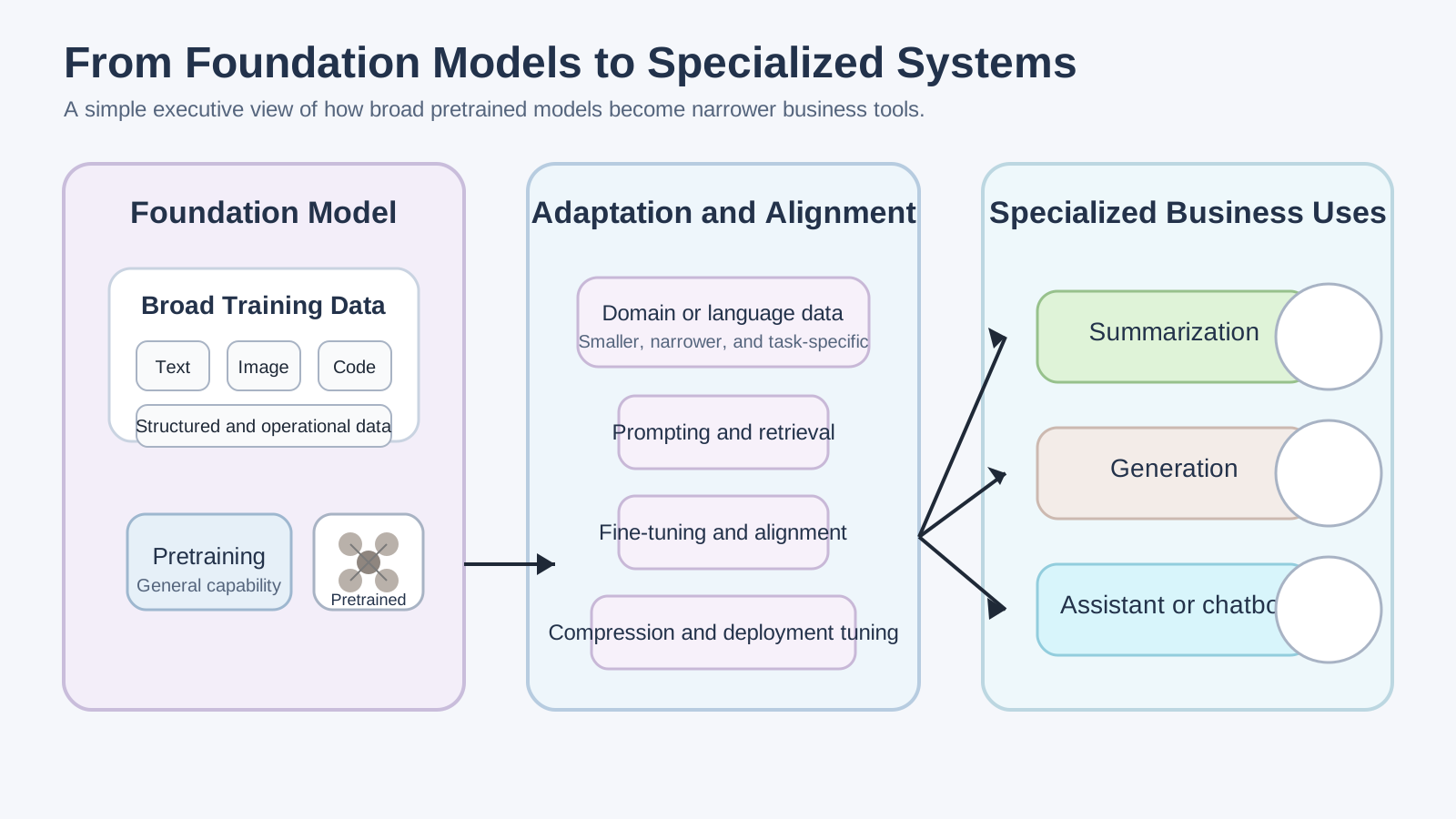
Figure: a pretrained model is trained first on broad data and then used in different ways. Leaders usually need to distinguish between using the base model directly, adding company knowledge around it, and fine-tuning the model itself.
The evidence question is therefore broader than “does the model look good?” It is:[2], [32], [51]
- does it work on our data?
- does it work in our workflow?
- does it fail safely enough for this use?
- can we monitor and challenge it after deployment?
6. Why Must Humans Stay in Control?
Human control matters most where the organisation may later need to explain, challenge, reverse, or stop what the system has done.[52], [53]
Not every AI system needs the same level of explanation. But as systems move closer to decisions about people, money, safety, access, or rights, explainability becomes more important. If an important output cannot be interpreted, challenged, or justified, then oversight, accountability, and trust become harder to sustain.[52]
This issue becomes sharper as the market moves from systems that mainly answer questions toward systems that can plan, use tools, and take multi-step actions on a user’s behalf. OECD work published on February 13, 2026 describes this emerging field as agentic AI and notes that definitions vary, but the common pattern is greater autonomy in how systems pursue goals over time.[40]
For leaders, the key issue is not whether a vendor calls a product a copilot, assistant, or agent. It is how much action autonomy the system is actually being given:
- does it only suggest, draft, or retrieve?
- does it trigger workflows, call tools, or make changes in connected systems?
- does it act once, or does it continue over multiple steps with limited supervision?
As systems move from answering to acting, the management problem changes. Accuracy still matters, but so do permissions, rollback, auditability, escalation, and the ability to interrupt the system before it creates operational or legal consequences.[2], [26], [40], [53]
In practical terms, humans should remain firmly in control where:[2], [26], [52], [53]
- the outcome affects rights, eligibility, safety, or access
- the cost of error is high or hard to reverse
- the organisation must be able to justify the outcome to regulators, auditors, customers, or the public
- the system is moving from assistance into action
AI also differs from earlier waves of enterprise software in three important ways:[3], [36], [40]
- It is probabilistic: outputs can be useful without being consistently correct.
- It is widely accessible: teams can adopt powerful tools before governance catches up.
- It changes decision boundaries: AI affects judgment, responsibility, and customer trust, not only process efficiency.
These features make AI less like a standard IT rollout and more like a cross-functional management issue involving strategy, risk, legal exposure, workforce design, and institutional trust.[2], [23], [34]
The more serious the consequence, the stronger the case for human approval, escalation, override, and auditability.
AI Is Also an Infrastructure Question
What infrastructure is required to run AI reliably at scale?
Leaders should not treat AI as software alone. AI capability depends on compute, cloud infrastructure, storage, networking, and in some cases specialised hardware such as GPUs or other accelerators. That infrastructure affects what models can be run, how quickly they respond, how expensive they become at scale, and whether they can be deployed where the organisation actually needs them.[24], [51]
This matters for four reasons:[24], [51]
- Cost and scale: model quality is only one part of the business case; inference cost, usage growth, and infrastructure spend can change the economics quickly
- Deployment constraints: some systems can run centrally in the cloud, while others may require on-premise, edge, or device-level deployment because of latency, privacy, resilience, or safety needs
- Dependency risk: many organisations depend on a small number of cloud and model providers for the hardware and platform layers underneath AI services
- Operational resilience: if compute access, latency, or infrastructure availability becomes constrained, AI-enabled workflows can degrade even when the model itself is sound
For leaders, this means three practical shifts:
- AI investment decisions should include infrastructure and usage economics, not just model capability
- vendor review should examine concentration risk, portability, and fallback options, not just feature quality
- critical AI use cases should be designed with continuity in mind: what happens if latency spikes, access is restricted, or a provider changes terms?
Key Questions for Leaders
- Where will AI create real economic or operational advantage, not just experimentation?
- Where is AI already being used in our organisation, with or without central oversight?
- What assumptions are our teams making about AI reliability that need to be tested?
- Which processes are safe to automate, and which require sustained human judgment and oversight?
- Where are tools beginning to move from drafting and analysis into action-taking or semi-autonomous behaviour?
Final Perspective
AI is not primarily a technology decision. It is a management decision about where to trust machines, where to retain human judgment, and how to build controls strong enough for the consequences involved.[2], [12], [34]
After reading this chapter, a leader should be more demanding in four ways:
- ask what kind of system it is before asking how impressive it looks
- ask what evidence proves readiness before approving wider use
- ask who remains accountable when the output is wrong
- ask what human override, monitoring, and fallback exist before allowing the system to influence important decisions
The practical change is not to become more enthusiastic about AI. It is to become more disciplined about where trust is earned, what evidence is required, and where human judgment must remain visible. The organisations that gain most are unlikely to be the ones that move first at any cost. They are more likely to be the ones that turn these questions into standard management practice, govern the answers consistently, and stay clear-eyed about both capability and limitation.[2], [23], [34]